
Content Creation for beginners

Digital Publishes a Blog on How to start a Blogging - A beginner's Guide 2025

How to Start Blogging – A Beginner’s Guide 2025
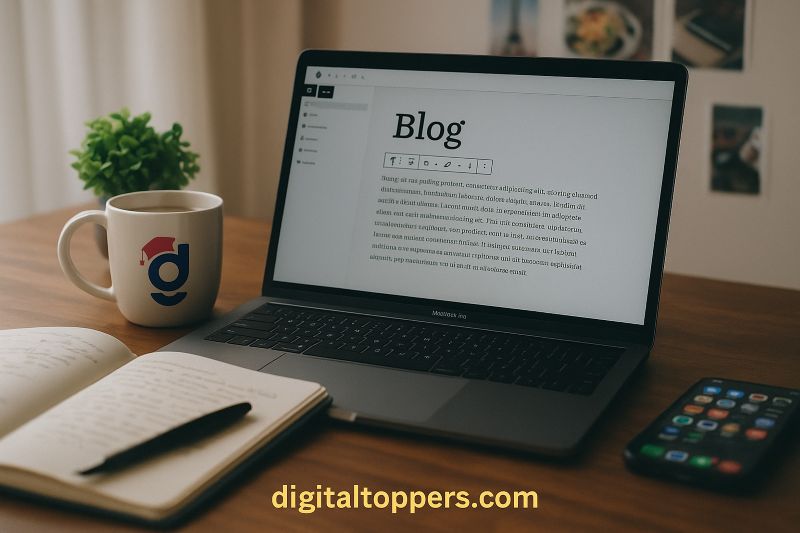
How to Start Blogging - A Beginner's Guide 2025 By Digital Toppers, Trichy

Are you thinking of starting a blog but don’t know where to begin? Don’t worry! This simple guide will help you get started with blogging. Whether you want to share your ideas, teach something, or grow your online presence, blogging is a great way to do it.

By the end of this guide, you’ll know how to choose a topic, write interesting content, promote your blog, and start seeing results. Let’s get started!

What is Blogging?

Blogging is nothing but the process of creating blog posts and publishing them on a website. The website can be owned by an individual or a company, and the posted content can be articles, photos or other digital media. Blogging often involves sharing long-form articles on a specific subject

Benefits of Blogging

  • To make your business more visible
  • To improve your website’s search ranking
  • To get more visitors to your website
  • To earn money online

Step 1: Pick Your Blog Topic (Niche)

A niche is just the main topic your blog focuses on.

Why it matters: Sticking to one topic makes you look like an expert and helps your blog show up on Google.

Ideas for niches:

  • Travel
  • Food and recipes
  • Fitness
  • Parenting
  • Personal finance
  • Educational
  • Health Care

Pro tip: Pick something you genuinely enjoy and know a little about it. Writing becomes easier when you love the topic

Step 2: Do Some Keyword Research

Keyword research is just figuring out what people are searching for online.

Tools for Keyword Research

Tip: Start with low-competition keywords — your blog can rank faster that way.

Example: If your niche is SEO, a keyword could be: “On-page SEO checklist for beginners.”

Step 3: Plan Your Blog Content

Don’t post randomly. Planning your content helps your audience actually read and engage with your blog.

Tips:

  • Solve your audience’s problems – Focus on questions or challenges they face.
  • Use a content calendar – Schedule weekly or monthly posts to stay consistent.
  • Mix content types – Keep your blog interesting with how-to guides, tips lists, and case studies.

Examples:

Step 4: Write Your First Blog Post

  1. Set a goal: Do you want to teach, share tips, or promote a tool?
  2. Know your audience: Are you writing for beginners or pros? What problems do they have?
  3. Keep it short: Aim for under 800 words. Clear posts win every time.
  4. Tell a story: Stories make it relatable.
    Example: “When I first tried Facebook Ads, I wasted money. But by testing small steps, I finally got daily leads!”
  5. Use subheadings: Makes it easier to read and Google-friendly.
  6. Make it readable: Short paragraphs, bullet points, and visuals help a lot.
  7. Add internal links: Link to other posts on your blog, like “Top 5 Free Tools for Digital Marketing Beginners.”
  8. SEO is your friend: Use keywords naturally in titles, subheadings, and the first paragraph.
  9. Answer questions: Include FAQs for your readers.
    Example:
    Q: How often should I post?
    A: Once a week is perfect — consistency matters more than frequency.
  10. Add images: Canva and Unsplash are great free sources for visuals. Screenshots and charts also help.

Step 5: Choose a Blogging Platform

Okay, you’ve selected a niche, done some keyword research, and prepared your blog draft. Now the question is: Where will your blog live? Here are some options:

  • WordPress.org – Most popular, free, but you need hosting
  • Blogger – Easy to use, fewer options
  • Wix – Drag-and-drop builder, beginner-friendly
  • Medium – Good for writers, but less control

If you chose WordPress.org, this step is necessary:

How to start:

  • Pick a short, memorable domain
  • Buy hosting from Bluehost, Hostinger, or SiteGround
  • Connect your domain to hosting and install WordPress

Tip: For long-term growth and full control, WordPress.org is the best choice.

If you use Blogger, Wix, or Medium, you can skip this step and use their free subdomain for now.

Step 6: Promote Your Blog

Writing is just half the work. You need people to see it!

Free ways to promote:

  • Share on Instagram, LinkedIn, Twitter
  • Submit to blog directories like Medium and Blogarama
  • Join Facebook or LinkedIn groups in your niche
  • Comment on other blogs

Mistakes Beginners Often Make

  • Writing about too many topics – Stick to one niche to build authority.
  • Ignoring SEO – Optimizing your posts helps people find your blog.
  • Not promoting posts – Sharing your content is key to getting traffic.
  • Copying content from others – Original content ranks better and builds trust.
  • Expecting overnight success – Blogging takes time and consistency.
  • Stuffing keywords – Overusing keywords can hurt readability and SEO.

Final Thoughts

Starting a blog isn’t hard — just follow these steps. Pick a topic, create helpful posts, and share them. Over time, you can make money through ads, affiliate programs, or offering services.

Remember, everyone starts as a beginner. The key is to take that first step today!

How to Start Blogging – A Beginner’s Guide 2025 Read More »

SEO - Off Page SEO

What is Off Page SEO and SEO Techniques to Boost your Website Rankings

SEO LSPL 824x313 1

Off-page SEO is the term for SEO strategies used off a website to raise its search engine rankings. These strategies frequently include social media marketing, guest posting, link building and more. Making your site appear more authoritative and trustworthy to search engines is the aim of off-page SEO.

Off Page SEO Techniques:

1. Link Building:

Getting other websites to link to pages on your own website is known as link building. These links are referred to as backlinks in SEO. A page may appear more authoritative to Google if it has more backlinks from reputable websites. Additionally, that may raise the page’s ranking. The following are the two main things you need to think about when constructing links:

Authority:

The overall quality of a website or webpage is measured by its “authority.” The quantity of high-quality backlinks it has is a major determining factor. This implies High-authority websites’ links are what you want. They can raise your ranking and are typically more valuable.

Unique Domains:

The quantity of distinct domains (referred domains) that point links to your website is another important statistic for link building. Getting links from as many high-quality, relevant domains as you can ought to be a major goal of your approach.

Check out our blog about Link Building Techniques to improve your website rankings.

2. Content Marketing:

One crucial off-page SEO strategy is content marketing. Putting out excellent content is a terrific method to demonstrate E-A-T, get media attention, and acquire backlinks. Additionally, figuring out how to get that material via several platforms can help increase off-page signals. PR, Social Media, Influencer Marketing, Podcasts, Content Syndication, Forums, and more are a few of those channels.

To know more about Content Creation and How to Become Content Creator , Read our blog.

PR:

Many SEOs now prefer using digital PR while developing links. It’s a fantastic method for obtaining quality backlinks quickly. Public relations offers additional benefits to off-page SEO signals than link development. Moreover, a successful PR effort can

  • Raise brand recognition and branded searches.
  • Present your company to the people that matter most to you.
  • Boost traffic from referrals.

Social Media:

Google doesn’t directly use social media to determine ranking. However, it works wonders for drawing attention. You’ll probably receive more links for that particular piece of content the more social media users share it. You will also receive more attention even if you do not receive a connection. Moreover, greater attention generates more mentions and searches for a brand. A win-win for your off-page SEO.

Influencer Marketing:

Influencer marketing is an approach used by brands to promote their goods and services by collaborating with well-known bloggers and social media influencers. It’s an amazing method to expand your audience, strengthen your brand, and produce content. Large audiences follow influencers and can assist in making sure your company is represented throughout a multitude of channels.

Guest Posting

Guest authoring can result in mentions and backlinks while exposing your business to a new audience. It lets search engines know that you are an authority in the field. An analysis of 850+ SEO experts of Semrush showed that it’s one of the best link-building strategies. Try using the following search operators when using Google to locate guest blogging opportunities:

  • “your target keyword” + “this is a guest post by”
  • “your target keyword” + “this is a guest contribution”
  • “your target keyword” + “guest column”
  • “your target keyword” + “guest post”
  • “your target keyword” + “contributing writer”
  • “your target keyword” + “contributing author”

This will display websites that have at least one guest-authored post. They might approve your guest post if they have previously accepted guest posts. Additionally, they might let you add a link to your website in the donated article. You could look for “affiliate marketing” plus “this is a guest contribution” if you’re writing about affiliate marketing, for example.

Podcasts:

These days, podcasts are very popular. And there are no indications that its popularity will decline. You can be losing out on enormous chances if they aren’t a part of your marketing plan. How come? Podcasts are a terrific technique to obtain a competitive edge because the majority of organizations still do not use them in their marketing strategy. They’re also a fantastic method to spread your knowledge, get noticed on other websites, and connect with new audiences. An additional SEO benefit of podcasts is backlinks.

A podcast host may include a link to your website if you are a guest. Alternatively, if the podcast is talking about a specific topic, they can come upon your website and cite it in some capacity inside their description. Additionally, you can contact them and offer to connect to your content if you are aware of the topics that the podcast typically covers.

Content Syndication:

Republishing content on one or more websites is referred to as content syndication. Because it’s simpler than constantly producing original content, some publications prefer to syndicate their content. Additionally, it’s beneficial to you because it will expose your brand to a wider audience.

A few well-known platforms for content syndication are as follows:

Medium

LinkedIn

Outbrain

Taboola

Business 2 Community

Quuu

Additionally, you can look for websites in your niche and get in touch with them about content syndication. However, carefully syndicate content. In every given search, Google claims to “always show the version we think is most appropriate for users, which may or may not be the version you’d prefer. Make sure the syndicated version of the article links back to your original one to avoid it from happening. as well as set up your canonical tags correctly.

Forums:

Dropping links in forums for SEO purposes will not improve your Google ranking. However, you can participate in discussions related to your area of expertise by using forums. to establish your authority and gain recognition for it fast. There aren’t many other venues that let you engage in direct conversation with prospective clients who are already inquiring about your offerings. This is an excellent method to start establishing trust and partnerships. Two important large-scale platforms to use are Reddit and Quora. However, specialist forums can be just as useful.

3. Local SEO:

The practice of improving your internet presence to boost local traffic, exposure, and brand awareness is known as local SEO. It is a distinct field within SEO. However, some local SEO components—like NAP citations and Google Business Profile, which was originally known as Google My Business—are essential off-page SEO strategies.

Google Business Profile (GBP):

You may control how your business appears in Google by creating a free business listing tool called a Google Business Profile. And one of the most important off-page SEO strategies is to optimize your Google Business Profile, as that happens off of your website. It’s actually a vital component of local SEO rankings. Additionally, it can make your website more visible in highly visible places on Google’s search results pages.

Learn more about Google Business Profile from our blog.

NAP Citations:

Online sources that list your company’s name, address, and phone number (NAP) are known as AP citations. Typically, citations can be found on review websites, social media profiles, and business directories. However, they may appear on a variety of webpages.

NAP citations are crucial since Google verifies that all of your company’s information is correct using citations. Thus, consistency is one of the keys to using citations successfully. Citations that are inconsistent seem erroneous. Making ensuring all of your NAP references match requires time.

4. Reviews:

One of the best ways to build trust for your business is through reviews. In actuality, one of the most crucial elements Google considers when assessing the E-A-T of your website is reviews. which implies that they are essential to the success of your local SEO. Google advises responding to every review. As well as terrible. By doing this, you demonstrate your appreciation for their business and input.

5. Events:

You can use events to support your off-page SEO strategy. They can not only hold the attention of your audience, but they can also help you generate buzz about your company. This can promote links and social interaction. For instance, when the event is being promoted, you can receive brand mentions. or if participants compose post-event summaries.

You might also get links from your event landing page. Perhaps people simply enjoy the occasion. Maybe a speaker wants to advertise it. Influencers could also distribute it just because it is valuable to their audiences. Even though events might need more work to operate smoothly, it can be challenging to recreate the same energy in other contexts. They’re also an excellent means of obtaining outstanding press publicity.

Keep Learning :

Here are some additional articles to help you learn more now that you know how off-page SEO functions and what has to be improved:

What is SEO and How it Works

What is On-Page SEO

SEO Competitive Analysis

What is Off Page SEO and SEO Techniques to Boost your Website Rankings Read More »

How SEO Works – Content Creation, User Experience and Analytics

SEO training - digital toppers

So, let us proceed with the second part of the SEO Beginner’s Guide without additional words. Well, it is the time to explore Content Creation and let yourself go through User Experience and Analytics. Not advanced concepts at all but simply best and easy steps to improve the field of SEO.

The primary areas that need attention are Content Creation and Optimization:

There are many factors that herald the importance of creating and providing effective and engaging content for both the end-users and the search engines. First, it simply keeps people on your website for longer and as long as the actual content of the article is useful and provides insightful answers to the users’ questions, there is a high chance it will be shared, thus increasing organic traffic. Relaunching a particular piece of content multiple times and revising it periodically can both increase the SEO of a website.

User Experience and RankBrain:

Importantly, Google’s RankBrain factors such as the bounce rate, the time spent by the user on the page, or click through rate. This is not a direct way through which your website will be able to achieve improved search engine rankings, but the overall usability of your website is equally important as it offers an enjoyable interface that is easy to navigate, fast loading, and compatible with mobile devices.

Analytics and Monitoring:

Using analytics like Google analytics and Google Search Console enables you to track your website traffic, track Organic traffic, uncover new potential keywords, and determine your SEO return of investment. Semantically, it is possible to regularly analyze these metrics and with their help to build an SEO strategy that will enable its constant improvement.

Staying Updated:

The world of SEO is dynamic and constantly evolving. Search engine algorithms change, new technologies emerge, and user behaviors shift. To stay ahead, follow reputable SEO blogs, attend webinars, and engage with the SEO community to keep yourself updated on the latest trends and best practices.

You can significantly improve the visibility and organic traffic to your website by understanding the fundamentals of search engine optimization, which may initially seem complex. You can improve your search engine rankings and accomplish your online objectives by putting the tactics covered in this beginner’s guide into practice. Remember, SEO is a journey, not a destination, so stay patient and persistent in your efforts.


“Boost Your Online Presence with Digitz India‘s Professional SEO Services – Reach the Top of Search Rankings Now!”

How SEO Works – Content Creation, User Experience and Analytics Read More »

Content Creation

A Beginners Guide to Content Creation

What is Content creation?

The act of developing subject ideas that appeal to your buyer persona, creating written or visual material around those ideas, and making that information available to your audience as a blog, video, infographic, or other content forms is known as content creation.

What Is the Importance of Good Content?

Every day, millions of pieces of material are published online. Your material must be of excellent quality if you want to stand out and create an impression on your consumers (and potential customers). It implies it\’s not just beautifully written and designed, but it\’s also been created with your audience\’s requirements in mind. The distinction between high-quality and low-quality information is stark: outstanding content climbs to the top, while terrible content fades into the internet\’s emptiness. The amount of time and effort you invest into creating content for your brand is directly proportionate to the value you receive from it. High-quality material will assist you in the following ways:

  • Make a name for yourself as an authoritative thinking leader.
  • Expand your email list and subscription base.
  • Keep your consumers interested.
  • Create income.

What are the different forms of content?

Content, like people, comes in many forms and sizes. They each have their significance, influence, and return. As a result, knowing content mapping is crucial, which means that each content type has a defined function and reaches the desired stage of the buyer\’s journey.

1)Infographics:

Would you like to communicate a procedure or statistics? This type of information is visually represented via infographics, which are easy to understand and at the top of the funnel. Examples include current trends, statistics, flowcharts, and milestones.

2)Blogs:

Quick or long-form writing centered on a certain subject. It\’s an excellent structure for addressing ToFu and MoFu, as readers become immersed in researching topics of interest. Informational pieces, interview extracts, listicles, and storytelling are some examples.

3)White paper:

Do your study and findings require more room than a blog? Then demonstrate this to your audience by releasing a white paper. It captivates readers who want to delve deeply into a complicated subject. Industry advancements, studies, policy briefings, and eBooks are some examples.

4)Podcasting:

This audio format is fantastic for reaching your audience since it is an increasingly popular format and an exciting way to add a personal touch to your business. While it may be a unique piece of content, marketers also use it to recycle already-produced material. Long-form material that does not include a lot of data, leader perspectives, interviews, fast bites, or story-telling are some examples.

5)Videos:

If you believe that an audio-visual approach would better hold your audience\’s attention, try creating videos. A compelling video may get viewers at any stage of the sales to funnel closer to a decision in a shorter period. Advertisers play with this format in a variety of ways, including animation, gifs, and sound effects. Instructional content, interviews, or product reviews are some examples.

6)case studies:

 This is the most effective method for sharing success stories and third-party proof of your brand\’s worth. They provide readers with essential information as well as a trust factor, which aids them in making decisions. Success stories, testimonials, and solution capabilities are a few examples.

Read our next blog to know about how to become a content creator and the skills you need for content creation.

A Beginners Guide to Content Creation Read More »

Scroll to Top