
Digital Toppers Academy

Struggling with content creation concept showing confused and confident creators with social media icons and growth elements

Struggling with Content Creation? Here’s What Actually Works

Introduction

Today, content is everywhere. From Instagram reels to YouTube videos and blog posts, people are constantly consuming information. But not all content gets attention. Some posts are ignored, while others go viral and create real impact.

The difference is not luck. It comes down to how well the content is created, structured, and delivered.

Content creation is not just about posting regularly. It is about understanding people, solving their problems, and presenting ideas in a way that is easy to consume and hard to ignore.

What is Content Creation?

Content creation is the process of producing valuable material for a specific audience. This content can educate, entertain, inspire, or persuade people.

It includes formats like:

  • Blog posts
  • Social media posts
  • Videos and reels
  • Podcasts
  • Infographics

At its core, good content always answers one question:

“Why should someone spend time on this?”

If your content does not give value or trigger emotion, people will simply scroll past it.

Why Content Creation is Important

In today’s digital world, attention is one of the most valuable assets. Content helps you capture that attention and turn it into trust.

Strong content can help you:

  • Build personal or brand identity
  • Gain audience trust
  • Increase visibility online
  • Generate leads or sales

For businesses, creators, and even students, content creation has become a powerful growth tool.

Types of Content You Should Focus On

Not all content serves the same purpose. A balanced strategy includes different types of content.

1. Educational Content

This type of content focuses on teaching something useful. It positions you as someone who provides value.

For example, guides, tips, and tutorials fall under this category.

  • Builds trust
  • Increases saves and shares

2. Entertaining Content

Entertaining content is designed to engage and capture attention quickly. It is highly shareable.

This includes:

  • Memes
  • Funny videos
  • Relatable situations
  • Increases reach
  • Attracts new audience

3. Personal Content

This content shows the human side behind the creator or brand. It builds emotional connection.

Examples include:

  • Personal stories
  • Daily routines
  • Behind-the-scenes content
  • Builds connection
  • Makes audience relate to you

4. Promotional Content

This is where you talk about your product or service. It is important but should not be overused.

Examples:

  • Product demos
  • Testimonials
  • Offers
  • Drives conversions
  • Generates revenue

Step-by-Step Content Creation Process

Creating good content consistently requires a system. Without a process, it becomes confusing and inconsistent.

Step 1: Understand Your Audience

Before creating content, you must clearly know who you are creating for.

Ask questions like:

  • What problems do they face?
  • What are they searching for?
  • What kind of content do they consume?

The better you understand your audience, the more relevant your content will be.

Step 2: Plan Your Content Ideas

Many people struggle with ideas, but ideas come from problems.

A simple approach is the following:

Identify a problem → Provide a solution → Convert it into content

For example, if people struggle with low engagement, you can create content around improving reach.

Step 3: Focus on Strong Structure

A well-structured piece of content performs better. Every content should follow a simple flow:

  • Hook (grab attention)
  • Problem (what is the issue)
  • Solution (how to fix it)
  • Call to action (what to do next)

This keeps your content clear and effective.

Step 4: Keep It Simple and Clear

One of the biggest mistakes is overcomplicating content. Using simple language makes your content accessible to a wider audience.

  • Use short sentences
  • Avoid complex words
  • Focus on one main idea

Clarity always wins over complexity.

Step 5: Be Consistent

Consistency is what separates beginners from successful creators.

Instead of posting randomly, follow a schedule:

  • 3 to 4 times per week is enough
  • Maintain similar quality
  • Stay in the same niche

Consistency builds trust with both the audience and the platform.

Step 6: Analyze and Improve

Creating content is not enough. You must also track performance.

Observe:

  • Which content gets more engagement
  • What type of posts are saved or shared
  • What topics perform well

Use this data to improve future content.

Tools That Can Help in Content Creation

Using the right tools can make content creation easier and more efficient.

Some commonly used tools include:

  • Canva for designing posts and visuals
  • CapCut for editing videos
  • Notion for planning content
  • SEMrush for keyword research and blog ideas

These tools help improve both quality and productivity.

Speed Up Your Content creation with AI

1. AI Tool for Script Writing / Idea Generation

Use: Video ideas, captions, scripts, storytelling

  • ChatGPT → video scripts, reels captions, content ideas
  • Jasper AI → blog writing, ad copy
  • Copy.ai → quick social media captions

Example: YouTube video script, Instagram reel dialogue

2. AI Tool for Image Generation / Design

Use: Thumbnails, Instagram posts, posters

  • Midjourney → high-quality creative images
  • DALL·E → create images from prompts
  • Canva → templates and easy design tools

Example: YouTube thumbnails, social media posts

3. AI Tool for Video Creation / Editing

Use: Reels, Shorts, YouTube videos

  • CapCut → simple editing with effects
  • Runway ML → background removal, AI editing
  • Pictory → convert text into video

Example: Turn a script into a video automatically

4. AI Tool for Voice & Dubbing

Use: Voiceovers, narration

  • ElevenLabs → realistic AI voice
  • Descript → edit audio/video and clone voice

Example: Voiceover videos without showing your face

5. AI Tool for Social Media Growth / Automation

Use: Scheduling, analytics, growth

  • Hootsuite → schedule posts
  • Buffer → consistent posting

Example: Automatically post daily content

6. AI Tool for SEO & Trend Research

Use: Trending topics, keywords

  • TubeBuddy → keyword research for YouTube
  • VidIQ → find trending ideas

Example: Discover viral video topics

Common Mistakes to Avoid

Many beginners struggle because of avoidable mistakes.

Some of the most common ones are:

  • Trying to be perfect before starting
  • Copying others without originality
  • Posting without a clear goal
  • Ignoring audience needs
  • Giving up too early

Avoiding these mistakes can speed up your growth.

Conclusion

Content creation is not just a trend. It is a long-term skill that can open many opportunities.

Success in content creation does not come overnight. It comes from:

  • Understanding your audience
  • Creating valuable content
  • Staying consistent
  • Continuously improving

Start small, stay consistent, and focus on giving value. Over time, your content will naturally grow and reach the right audience.

Struggling with Content Creation? Here’s What Actually Works Read More »

Business growth using WhatsApp with chat, sales, and customer engagement illustration

A Strategic Guide to Business Growth Using WhatsApp

Today, customers expect everything to be fast, simple, and personal. They don’t want to visit multiple websites, wait for replies, or go through complicated steps just to buy a product.

That’s exactly where WhatsApp becomes powerful.

Most people already use WhatsApp daily—to chat with friends, family, and even businesses. For small business owners, this is not just a messaging app. It’s a direct line to customers.

Instead of spending heavily on ads or building complex systems, you can use WhatsApp to connect, build trust, and grow your business in a more natural way.

Why WhatsApp Works So Well for Businesses

WhatsApp is not like traditional marketing platforms. It feels personal.

When a customer messages you, it doesn’t feel like they are talking to a brand. It feels like they are talking to a real person.

That small difference creates a big impact.

  • Customers trust faster
  • Conversations feel natural
  • Decisions happen quickly

And most importantly—people reply on WhatsApp.

1. Direct Communication Builds Instant Trust

One of the biggest advantages of WhatsApp is instant communication.

Imagine a customer who is interested in your product but has a small doubt:

  • Price
  • Size
  • Delivery time

If they message you and get a quick reply, their confidence increases immediately.

More trust = Higher chances of purchase

Fast replies mean more trust.

2. WhatsApp Status = Free Daily Marketing

Many people check WhatsApp status every single day. This is an underrated feature for businesses.

You can use it like a free advertising tool.

What you can post:

  • New product arrivals
  • Offers & discounts
  • Customer reviews
  • Behind-the-scenes content
  • Short product videos

Even if customers don’t message immediately, your brand stays in their mind.

3. Turn Chats into Sales (Real Power of WhatsApp)

Unlike websites where customers browse and leave, WhatsApp allows you to guide the customer step-by-step.

A simple journey looks like this:

  1. Customer sends a message
  2. You respond instantly
  3. You share product details/photos
  4. Customer asks questions
  5. You clarify
  6. Customer buys

Simple process, smooth experience, faster decisions

This is why WhatsApp often gives higher conversion rates than traditional methods.

4. Real Example: How Flipkart Used WhatsApp Chatbots

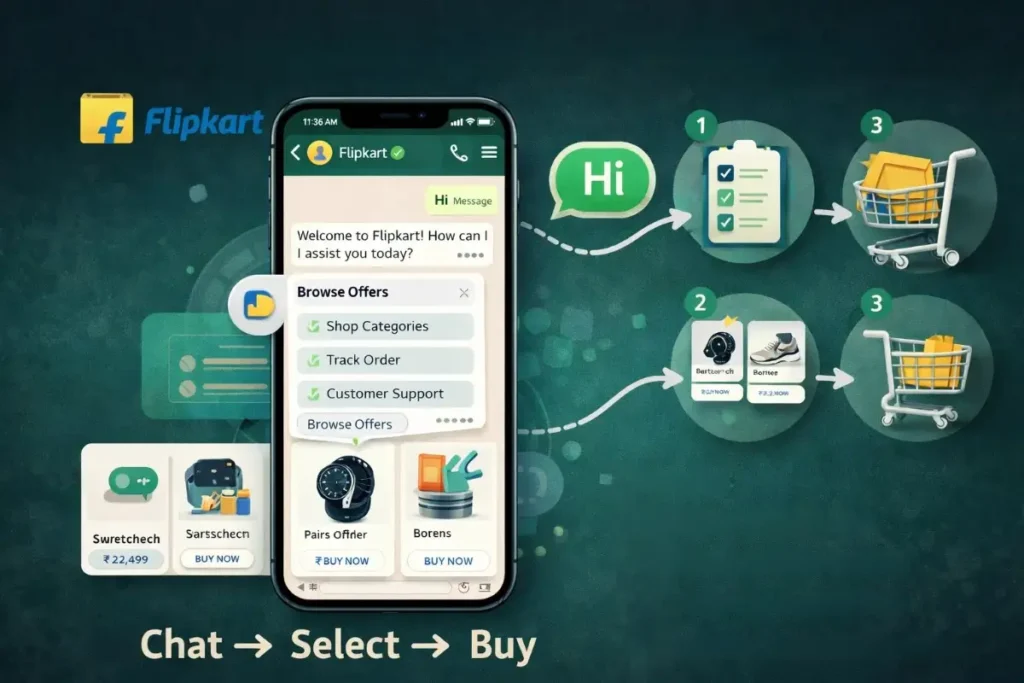
flipkart wgatsapp

A great real-world example is Flipkart, one of India’s leading e-commerce platforms.

During their major sale campaign, they used a WhatsApp chatbot to simplify the shopping experience.

What They Did

Customers could simply send a message like “Hi” and instantly get

  • Browse offers
  • Explore product categories
  • Get personalized recommendations
  • Track orders
  • Receive instant support

Everything happened directly inside WhatsApp.

How the Chatbot Worked

  • User sends a message
  • Chatbot shows menu options
  • User selects what they want
  • Instant responses guide them
  • Product links are shared
  • Purchase happens (fast & easy)

Clear communication, quick responses

Why It Was Effective

  • No need to open websites
  • Instant replies
  • Simple navigation
  • Personalized experience

This reduced effort for customers and increased buying.

Results

  • Higher engagement
  • Faster decision-making
  • Increased conversions
  • Better customer experience

In simple terms:
Chat → Select → Buy

5. Actionable Insights for Small Business Owners

You don’t need to be a big company to use this strategy.

You can create a simple version:

Boutique:

  • “Hi” → New Collection / Offers
  • Auto reply → Product images + price

Bakery:

  • “Hi” → Cakes / Custom Orders
  • Instant menu + photos

Same concept, smaller scale — still powerful.

6. Optimizing WhatsApp Business Features for Growth

If you want serious growth, don’t just use WhatsApp normally. Use WhatsApp Business features smartly.

Quick Replies & Automation

Save time and respond faster.

  • Answer common questions instantly
  • Set greeting messages
  • Use away messages when offline

Makes your business look professional

Product Catalog (Mini Shop Inside WhatsApp)

Instead of sending multiple images manually, you can create a catalog.

  • Show product images
  • Add price & details
  • Share instantly in chat

Customer can browse without leaving WhatsApp
Fewer steps, more sales

Labels & Customer Segmentation

As your business grows, managing customers becomes important.

You can organize like this:

  • New customers
  • Interested users
  • Repeat buyers

Send the right message to the right people
Avoid spam feelings.

Broadcast Messages (Smart Promotion)

You can send updates to multiple people at once—but it still feels personal.

Use it for:

  • Festival offers
  • Product launches
  • Limited-time deals

Personal feel + Mass reach = Perfect combo

7. Customer Support = Business Growth

Good customer service is one of the biggest reasons people come back.

With WhatsApp, you can:

  • Answer queries quickly
  • Share order updates
  • Solve problems fast
  • Collect feedback

When customers feel supported, they:

Buy again, Recommend your business

8. Cost-Effective Marketing (High ROI)

Compared to ads, WhatsApp is extremely affordable.

  • No big budget needed
  • High engagement
  • Better response rate

You spend less, You earn more

That’s why many businesses see better ROI using WhatsApp.

9. Perfect for Small & Local Businesses

WhatsApp is especially powerful for:

  • Home businesses
  • Boutiques
  • Bakers
  • Freelancers
  • Local service providers

Why?

Because your audience is already there.

They don’t need to download anything new or learn anything complicated.

10. Common Mistakes to Avoid

Even though WhatsApp is simple, using it the wrong way can reduce results.

Avoid this:

  • Sending too many messages (spam)
  • Late replies
  • Dry or robotic communication
  • Ignoring customer queries

Instead:

  • Be friendly
  • Be quick
  • Be helpful

Final Thoughts

Growing a business doesn’t always require complicated strategies.

Sometimes, the most powerful tools are already in your hands.

WhatsApp is more than just a messaging app.
It’s a complete business tool—marketing, sales, and customer support in one place.

Start simple:

  • Reply fast
  • Share useful updates
  • Build real conversations

Over time, those conversations will turn into customers…
and those customers will turn into long-term growth.

A Strategic Guide to Business Growth Using WhatsApp Read More »

Illustration comparing educational social media content with viral meme content showing low reach vs high reach.

Why Educational Content Gets Less Reach (And How to Fix It)

Have you ever noticed something like this?

You spend time creating a post that actually teaches something useful. Maybe a tip, a guide, or something that can help people learn. But after posting it, the reach is very low.

At the same time, a simple meme or trending reel gets thousands of views.

This happens to many creators and business owners. It can feel confusing because educational content is supposed to be valuable.

So why does it get less reach on social media?

The truth is, it has less to do with the value of the content and more to do with how people use social media today.

Let’s look at a few simple reasons.

People Open Social Media to Relax

Most people don’t open Instagram or other platforms to study.

They open it when they are bored, taking a break, or simply relaxing. Naturally, they are more likely to stop for something entertaining.

A funny video, a relatable reel, or a trending post is easier to consume.

Educational posts usually need a little more attention. Because of that, many people scroll past them quickly, even if the information is useful.

Sometimes Educational Posts Feel too Heavy

Another reason is how the content is presented.

Many educational posts include long captions or too much information in a single post. When someone is quickly scrolling, a long block of text can feel overwhelming.

It doesn’t mean the content is not good. It just means the format might not match how people consume content on social media.

Keeping the message simple and easy to scan can make a big difference.

The First Few Seconds Matter a Lot

On social media, attention is very short.

If a post does not catch someone’s interest quickly, they will move on to the next thing.

This is especially important for educational content. The beginning of the post needs to make people curious.

For example, instead of starting with an explanation, you could begin with a relatable question.

Something like:
Posting every day but still not getting reach?”

When people feel connected to the problem, they are more likely to continue reading.

Information Alone Is Not Always Enough

Facts and tips are useful, but people often connect more with stories and real examples.

When educational content includes a small story, a real-life example, or a relatable situation, it becomes more interesting.

Instead of just explaining a concept, showing how it works in real life can make the message stronger and easier to remember.

How You Can Improve the Reach of Educational Content

The good news is educational content can still perform really well. It just needs a small shift in how it is presented.

Here are a few simple things that can help.

Start with a strong opening.

A question, a common mistake, or a surprising statement can make people stop scrolling.

Break information into small points.

Simple and clear points are easier to read than long paragraphs.

Use visual formats.

Carousels, short videos, or simple graphics make learning feel lighter and more engaging.

Make it relatable.

Using everyday examples helps people understand the idea quickly.

Invite people to interact.

Asking a question or encouraging people to save the post can increase engagement.

Final Thoughts

Educational content may not always go viral quickly, but it plays a very important role.

It builds trust. It shows your expertise. And over time, it helps people see you as someone who shares real value.

Instead of changing the purpose of your content, try adjusting the way you present it.

When useful information is combined with a simple format and relatable examples, educational content can reach many more people than you expect.

Why Educational Content Gets Less Reach (And How to Fix It) Read More »

Global conflict and India’s digital market concept showing war scene on one side and digital business growth on the other.

From War to Web: How Global Conflicts Are Affecting India’s Digital Market

When we hear about wars happening somewhere in the world, most of us think it has nothing to do with our daily work. It feels like something is happening far away.

But the reality today is different.

The world is deeply connected. A conflict in one region can slowly affect economies, businesses, technology, and even digital marketing in other countries.

For a growing digital economy like India, global conflicts sometimes create small waves that reach the digital market as well. It may not be obvious at first, but businesses, marketers, and online platforms often feel the impact.

Let’s look at how that actually happens.

Businesses Become More Careful

Whenever global uncertainty increases, companies usually slow down their spending. Not because they want to stop growing, but because they want to be careful.

During situations like the Russia–Ukraine War, many international businesses paused their big marketing plans for a while.

Instead of launching new campaigns immediately, they waited to see how the global situation would develop.

This affects India too, especially for digital agencies and freelancers working with global clients.

You might notice things like the following:

  • Campaigns getting postponed
  • Marketing budgets becoming smaller
  • Businesses delaying product launches
  • Clients taking more time to approve projects

It doesn’t stop the digital industry, but it definitely slows things down for a short time.

People’s Attention Changes Online

Another interesting thing happens during global conflicts — people start paying more attention to news.

Instead of looking at product ads or entertainment content, many people start searching for updates about what is happening around the world.

Platforms like Google, Meta, YouTube, and Instagram often see a sudden increase in news-related searches.

Because of this shift, digital marketers sometimes notice the following:

This means brands and creators need to stay aware of what audiences are currently focused on.

E-commerce Feels the Ripple Effect

Global conflicts can also affect trade and transportation between countries.

Shipping routes may change, fuel costs may increase, and international supply chains may slow down. Over time, this affects e-commerce businesses too.

Online platforms such as Amazon and Flipkart depend on smooth logistics systems.

When global trade becomes unstable, sellers sometimes face issues like the following:

  • Delayed product deliveries
  • Increased logistics costs
  • Temporary stock shortages
  • Price fluctuations in certain categories

These changes eventually influence digital marketing campaigns as well.

Cybersecurity Starts Getting More Attention

Modern conflicts are not limited to physical battlefields anymore. Digital infrastructure is also something countries and companies protect very carefully.

During periods of global tension, organizations invest more in cybersecurity.

Many companies start focusing on the following:

  • Protecting customer data
  • Strengthening digital infrastructure
  • Preventing cyberattacks

This has actually created opportunities for India’s tech industry, since many Indian companies provide IT services and security solutions.

India’s Digital Industry Is Still Growing

Even though global conflicts create uncertainty, India’s digital ecosystem continues to grow.

Technology hubs like Bengaluru, Hyderabad, and Chennai are still attracting startups, global companies, and tech investments.

In fact, many international businesses are now trying to work with multiple regions instead of depending on just one country.

This shift has opened more opportunities for Indian tech companies, digital agencies, and online service providers.

The World Is More Connected Than Ever

A few decades ago, global conflicts mostly affected nearby countries. Today, the story is different.

Economies, technology platforms, and digital markets are all connected. Even events happening far away can slowly influence online businesses and digital industries in India.

For marketers, entrepreneurs, and content creators, understanding this connection is becoming more important.

Because in today’s world, the distance between global conflicts and the digital market is smaller than we think.

From War to Web: How Global Conflicts Are Affecting India’s Digital Market Read More »

Female entrepreneur planning branding strategy with logo, brand colors, packaging, and social media icons illustrating small business branding tips.

How to Brand Your Small Business: 7 Simple Tips for Entrepreneurs

Starting a business is a big step. For many women entrepreneurs, it may start as a small idea from home — maybe a baking business, a boutique, handmade products, or even an online service.

In the beginning, most people focus only on selling the product. But there is another important thing that helps a business grow: branding.

Branding is simply how people recognize and remember your business. The good part is you don’t need a big budget or a marketing team to build a strong brand. Even small changes can make your business look more professional and trustworthy.

Here are 7 simple branding tips that can make a big difference.

1. Pick a Few Brand Colors and Stick to Them

Colors may look like a small detail, but they help people remember your business.

Choose two or three colors that represent your brand and use them regularly. For example, you can use the same colors in the following:

  • Instagram posts
  • Story highlights
  • Packaging
  • Posters or flyers

When people see the same colors again and again, they slowly start connecting them with your brand.

2. Use the Same Logo Everywhere

Your logo is like the face of your business.

Once you create a logo, try to use the same one across all platforms. Whether someone sees your business on Instagram, WhatsApp, or your product packaging, the logo should look familiar.

This consistency helps people recognize your brand quickly.

3. Keep Your Social Media Look Clean

When someone visits your business page on Instagram, the page should feel neat and organized.

You don’t need complicated designs. Even simple posts work well if they follow a similar style. For example:

  • Similar color themes
  • Easy-to-read fonts
  • Clear product photos

A clean page gives the impression that your business is professional and reliable.

4. Write a Simple and Clear Bio

Your business bio is often the first thing people read when they visit your page.

Instead of writing something very general, try to explain clearly what you offer.

For example:
Instead of “Handmade products,” you could write
“Handmade candles for home décor and gifting.”

This helps people quickly understand what your business is about.

5. Don’t Ignore Packaging

Packaging is also part of branding. Even simple packaging can leave a great impression.

Small touches can make customers feel special, like the following:

  • A thank-you card
  • A branded sticker
  • Neatly packed products
  • A short appreciation note

When customers enjoy the experience of receiving your product, they are more likely to come back.

6. Share Your Story Sometimes

People love knowing the story behind a business.

You can occasionally share things like the following:

  • Why you started the business
  • How you make your products
  • Behind-the-scenes moments
  • Your journey as an entrepreneur

This helps customers connect with you as a person, not just as a business.

7. Talk to Customers in a Friendly Way

Branding is not only about logos and colors. The way you talk to customers also matters.

Try to always communicate in a polite and friendly way. Simple things like:

  • Replying clearly to questions
  • Thanking customers after a purchase
  • Being patient with inquiries

These small actions help build trust and create loyal customers.

Final Thoughts

Building a strong brand doesn’t happen overnight. It grows slowly through small and consistent efforts.

Using the same colors, keeping your social media neat, giving attention to packaging, and communicating kindly with customers can make your business stand out.

Even the biggest brands started with simple steps. With consistency and care, your brand can grow beautifully too.

How to Brand Your Small Business: 7 Simple Tips for Entrepreneurs Read More »

Professionals discussing and creating content on LinkedIn in a modern office workspace in 2026

Why Everyone Is Suddenly Posting on LinkedIn in 2026

If you open LinkedIn today, you will notice something interesting.

Almost everyone is posting.

Your college friend is sharing career lessons. A founder is posting daily insights about business. Designers are talking about their creative process. Students are sharing internship experiences and project learnings.

Just a few years ago, LinkedIn looked very different.

Most people created a profile, added their education and job details, and left it there. They logged in only when they were searching for a job or updating their resume.

But in 2026, LinkedIn feels more like a content platform than a job portal.

So what exactly changed?

LinkedIn Is No Longer Just a Resume

Earlier, LinkedIn was mainly about profiles.

Now it is about presence.

Having a well-written profile is still important, but people have realized that visibility comes from sharing ideas and experiences. When someone posts regularly, their network begins to recognize them.

Instead of waiting for opportunities, professionals are showing their knowledge through content.

This shift has made LinkedIn much more active and engaging.

Personal Branding Became a Priority

One major reason people started posting more is the rise of personal branding.

Professionals today understand that being good at their work is important, but being visible also makes a difference. LinkedIn helps people build that visibility.

Through posts, professionals can:

  • Share lessons from their work
  • Talk about industry trends
  • Show their problem-solving approach
  • Share personal career experiences
  • Teach something useful to their network

Over time, these small posts build credibility.

People begin to associate your name with a particular skill or expertise.

Opportunities Are Coming Directly From LinkedIn

Another big reason for the sudden increase in posts is simple: it works.

Many professionals have seen real results from being active on LinkedIn. Posting regularly can lead to opportunities like:

  • Job offers from recruiters
  • Freelance or consulting clients
  • Collaboration with other professionals
  • Speaking or webinar invitations
  • Partnerships for projects or startups

A single thoughtful post can sometimes reach thousands of people. When the right person sees it, new opportunities can open unexpectedly.

This is why many professionals now see LinkedIn content as a long-term investment.

The Algorithm Encourages Consistency

LinkedIn’s algorithm also plays a role.

The platform rewards creators who post consistently and share valuable insights. When a post receives engagement, LinkedIn shows it to more people in the network.

Because of this, many professionals now treat LinkedIn like a regular content platform.

Common types of posts you often see include:

  • Career lessons from real experiences
  • Short industry insights
  • Personal growth stories
  • Behind-the-scenes work moments
  • Quick tips related to their field

These simple posts are easy to read and often create meaningful conversations.

Sharing the Learning Journey

Another interesting change in 2026 is that people are more comfortable sharing their learning journey.

Earlier, many professionals felt they should post only when they became experts. Now the mindset has changed.

People are posting while they are learning.

For example:

  • A student sharing a new marketing concept they understood
  • A developer explaining a tool they recently learned
  • A designer sharing the process behind a project

This approach makes LinkedIn feel more authentic and relatable.

Readers connect more with real experiences than with perfectly polished announcements.

Students Are Becoming More Active

Students are also contributing to this trend.

Instead of waiting until graduation, many students start building their professional presence early. They share projects, internships, competitions, and lessons from their learning journey.

This helps them:

  • Build a professional network early
  • Gain visibility among recruiters
  • Improve their communication skills
  • Document their career journey

For many students, LinkedIn has become a part of career preparation.

Content Is Becoming the New Resume

In many ways, LinkedIn posts are becoming a new type of resume.

A traditional resume tells someone where you worked. But your content shows how you think.

When professionals regularly share insights, ideas, and lessons from their field, people begin to understand their expertise and perspective.

That creates a much stronger impression than a static profile.

The Real Reason Everyone Is Posting

At its core, the reason everyone is posting on LinkedIn in 2026 is simple.

People want their ideas and experiences to reach the right audience.

LinkedIn has become one of the few platforms where thoughtful professional content can still travel far and create meaningful connections.

And once people realize that one post can open unexpected doors, they begin to understand something powerful.

Posting is not just about sharing content.

It is about building visibility, credibility, and opportunities over time.

Why Everyone Is Suddenly Posting on LinkedIn in 2026 Read More »

Instagram algorithm in 2026 concept showing watch time, saves, shares, and engagement around a smartphone displaying an Instagram reel.

Instagram Algorithm 2026: What Actually Matters for Reach and Engagement

If you have ever posted something on Instagram and wondered why one post gets good reach while another barely gets noticed, you are not alone.

Many creators and businesses try to understand how the Instagram algorithm works. Some people believe posting at the right time is the secret. Others think using more hashtags will solve everything.

But in 2026, the algorithm focuses on something much simpler — how people interact with your content.

Instagram wants users to spend more time on the platform. So naturally, it pushes posts that keep people watching, reading, and engaging.

Watch Time Is More Important Than Likes

A few years ago, likes were considered the main indicator of a successful post. Today, they are only a small part of the picture.

Instagram now focuses more on watch time, especially for reels.

For example, when someone watches your reel completely, the platform understands that the content is interesting. Because of that, the algorithm may show the reel to more people.

This is why short and engaging reels often perform better.

Things that improve watch time include:

  • A strong hook in the first few seconds
  • Short and engaging videos
  • Content that encourages people to watch till the end
  • Videos that people rewatch

When people spend more time on your content, Instagram sees it as valuable.

Saves and Shares Are Strong Signals

Another important factor is how often people save or share your posts.

Think about your own behavior. People usually save posts that are helpful or informative. They also share posts that they feel others should see.

Content that often gets saved or shared includes:

  • Educational posts
  • Tips and quick guides
  • Carousel posts with useful information
  • Content that solves a small problem

When Instagram notices these actions, it increases the chances of showing your content to a wider audience.

Instagram Prioritizes Relationships

Instagram also looks at the relationship between users.

If someone regularly interacts with your content, the platform assumes they are interested in your posts. Because of this, your content appears more often in their feed.

These interactions include:

  • Likes
  • Comments
  • Story replies
  • Direct messages
  • Profile visits

Engaging with your audience can slowly improve your visibility on the platform.

Different Parts of Instagram Work Differently

Many people think Instagram has only one algorithm, but that is not true.

Different sections of the platform work differently. These include:

  • Feed
  • Reels
  • Stories
  • Explore page

For example, reels are designed to help creators reach new audiences, while stories are usually shown to people who already follow and interact with you.

Understanding this difference can help you choose the right type of content.

Keywords Are Becoming Important.

Another recent change is how Instagram handles search.

More users now search for topics directly inside Instagram. Because of this, captions with clear keywords can improve visibility.

Instead of using only hashtags, creators are now including relevant keywords in their captions.

For example, captions may include phrases like the following:

This helps the platform understand what the content is about.

The Real Secret to Instagram Growth

At the end of the day, the Instagram algorithm simply wants to show people content they enjoy.

Instead of trying to outsmart the algorithm, the better strategy is to focus on creating content that people genuinely find interesting or useful.

A simple approach that works well includes:

  • Creating engaging reels
  • Sharing useful information
  • Posting consistently
  • Interacting with your audience

When people watch, save, or share your content, the algorithm naturally pushes it to more users.

Understanding how the algorithm works can definitely help creators and businesses grow. But the real key is always the same—creating content that connects with people

Instagram Algorithm 2026: What Actually Matters for Reach and Engagement Read More »

Person posting content on LinkedIn daily with engagement icons, networking symbols, and professional growth illustration.

What Really Happens When You Post on LinkedIn Every Day

Many people use LinkedIn only as an online version of their resume.

They create a profile, add their education and experience, and then leave it untouched for months. Some open it only when they are searching for a job. Others scroll occasionally, like a social media feed, without actively participating.

But something interesting happens when you change one simple habit.

You start posting every day.

Not promotional content. Not complicated industry reports. Just simple thoughts, lessons, insights, and experiences related to your field.

So what actually happens when someone posts on LinkedIn every day?

Let’s break it down.

The First Few Days: Almost No One Notices

In the beginning, it can feel a little awkward.

You write a post, click “publish,” and wait. After a few hours, you may see only a handful of views. Maybe one or two likes from friends or colleagues.

Many people stop here because they assume their content is not interesting.

But the truth is simple.

LinkedIn’s algorithm is still learning about your content and your audience. At this stage, consistency matters more than perfection. The platform needs time to understand what you talk about and who should see it.

Think of the first week as planting seeds.

During the first few days, you may notice:

  • Very few likes or comments
  • Limited reach
  • Mostly interactions from people you already know

And that’s completely normal.

Week Two: Engagement Slowly Starts Growing

After a week or two of posting regularly, something small begins to change.

Your posts start reaching slightly more people. A few unfamiliar names appear in the likes or comments. Sometimes someone sends a connection request after reading your post.

This happens because LinkedIn starts recognizing your activity.

When you post consistently:

  • The algorithm understands your content topics
  • Your posts appear more often in your network’s feed
  • Your content slowly reaches people outside your network

It is not viral growth.

It is steady visibility.

Week Three: People Start Recognizing Your Name

One of the most surprising things about posting daily is name recognition.

When someone repeatedly sees your posts in their feed, they begin to remember you. Even if they don’t interact immediately, your name slowly becomes familiar.

For students, this can be powerful.

Imagine a recruiter scrolling through LinkedIn and seeing your insights about marketing, technology, or career learning several times.

Even short posts can create the impression that you are:

  • Curious about your field
  • Actively learning
  • Sharing useful ideas
  • Engaging with industry conversations

This is how personal branding quietly begins.

Week Four: Opportunities Start Appearing

By the time you reach a month of consistent posting, a few interesting things can happen.

You might start noticing:

  • Someone commenting with questions
  • A professional sending a message appreciating your post
  • Recruiters viewing your profile
  • New connection requests from industry people
  • Collaboration or networking opportunities

None of these appear overnight.

They grow slowly as more people discover your voice and ideas.

The key point is simple:

Visibility creates opportunities.

If people never see your thoughts, they never get a chance to connect with you.

You Also Become a Better Thinker

Posting every day does something else that many people do not expect.

It improves your thinking.

When you write consistently, you begin observing your industry more closely. You start noticing trends, ideas, and lessons in your daily work or learning.

Instead of passively consuming information, you start processing it.

Over time, this helps you:

  • Think more clearly
  • Structure your ideas better
  • Share knowledge confidently
  • Develop a unique perspective

Consistency builds clarity.

Consistency Matters More Than Perfection

Many people delay posting because they want their content to be perfect.

But LinkedIn rewards consistency, not perfection.

A simple post sharing what you learned today can sometimes perform better than a long, complicated article.

Authentic thoughts often resonate more than polished corporate language.

The real goal of posting regularly is simple:

  • Show up consistently
  • Share useful insights
  • Document what you are learning
  • Start meaningful conversations

You don’t need to impress everyone.

You only need to start sharing.

The Real Result of Posting Every Day

Posting daily on LinkedIn will not magically make you famous in a week.

But something much more valuable happens over time.

You begin to

  • Become visible in your industry
  • Build credibility through your ideas
  • Attract the right professional connections
  • Develop a strong personal brand

And this visibility compounds.

  • One post leads to a conversation
  • One conversation leads to a connection
  • One connection leads to an opportunity

Slowly, the platform that once looked like just a resume page becomes a powerful place for learning, networking, and growth.

All because you decided to share your thoughts consistently.

Sometimes, small habits create the biggest impact.

What Really Happens When You Post on LinkedIn Every Day Read More »

ChatGPT used in digital marketing workflows, showing content creation and strategy planning

How ChatGPT Is Really Used in Digital Marketing (Not What You Think)

When ChatGPT became popular, many people thought digital marketing jobs were over.

“AI will write everything.”
“Content creators are finished.”
“Copywriters are replaced.”

But in reality?

That’s not what’s happening.

No serious marketer is just copying and pasting from ChatGPT and earning money. That’s not how it works.

Let me tell you how it’s actually being used in real digital marketing work.

1. When Ideas Don’t Come

Some days your brain simply doesn’t cooperate.

You want to post.
You need to post.
But nothing clicks.

Instead of wasting 40 minutes staring at a blank screen, marketers open ChatGPT and ask the following:

  • Give 10 content ideas for this niche
  • What are common mistakes in this industry?
  • What questions do beginners ask?

It gives raw material.

Not final content.
Just direction.

From there, the marketer shapes it with their own experience.

2. First Draft = Fast Draft

Writing from scratch takes time.

Especially blogs, landing pages, long captions.

Now what happens?

Marketers use ChatGPT to generate a rough draft.
Then they

  • Change the tone
  • Add real examples
  • Insert personal insights
  • Improve clarity

So instead of 5 hours, it takes maybe 2.

The thinking is still human.
The speed is AI-assisted.

3. Ad Copy Testing

In ads, variations matter.

You don’t run one headline.
You test 5–10.

Instead of struggling to think of multiple angles, marketers use ChatGPT to generate:

  • Different emotional hooks
  • Problem-focused headlines
  • Curiosity-based openings
  • Short vs long copy

Then they test it on platforms like Meta Ads or Google Ads.

AI helps with quantity.
Data decides quality.

4. Turning One Content Into Many

This is where it’s powerful.

One blog post can become the following:

  • Instagram carousel
  • LinkedIn post
  • Email newsletter
  • Reel script

Instead of rewriting everything manually, marketers ask ChatGPT to repurpose it into different formats.

It saves serious time.

Consistency becomes easier.

5. Understanding Audience Better

Good marketing is not about posting daily.
It’s about saying the right thing.

Marketers use ChatGPT to:

  • List possible pain points
  • Identify objections
  • Suggest buying triggers
  • Structure customer personas

It gives perspective. But final messaging is always refined by the marketer.

6. Script Writing for Reels

Short-form content needs structure.

  • Hook.
  • Relatable problem.
  • Clear solution.
  • Strong ending.

Marketers use ChatGPT to outline this structure.
Then they rewrite it in their own voice before recording.

Because audiences connect with personality.
Not robotic perfection.

7. Learning Faster

Digital marketing changes fast.

Instead of watching a 45-minute video, marketers ask ChatGPT to:

  • Explain new updates simply
  • Break down complex terms
  • Give examples

It becomes like a quick study partner.

Important Truth

ChatGPT is not replacing digital marketers.

It’s replacing slow workflows.

If someone depends 100% on AI without understanding marketing basics, results won’t come.

But if someone understands:

  • Audience
  • Strategy
  • Positioning
  • Data

Then ChatGPT becomes a powerful assistant.

Conclusion

The question is not
“Will AI take my job?”

The better question is
“Am I learning how to use AI better than others?”

That’s the real advantage.

How ChatGPT Is Really Used in Digital Marketing (Not What You Think) Read More »

Illustration showing professionals collaborating with AI robots and digital dashboards, highlighting future jobs created by AI not replaced by AI.

Future Jobs Created by AI (Not Replaced by AI)

For the past few years, one sentence has been everywhere—”AI will take away jobs.

Students started worrying. Professionals began questioning their career choices. Many even felt technology might replace human talent completely.

But here’s the truth most people miss.

AI is not just replacing jobs.
AI is also creating entirely new career opportunities—roles that never existed before.

In fact, the future belongs to people who know how to work with AI, not compete against it.

Let’s explore some exciting jobs that AI is creating in 2026 and beyond.

1. AI Content Strategist

AI tools can generate content quickly. But strategy? Creativity? Audience understanding?

That still needs humans.

Companies now need professionals who can:

  • Plan content ideas
  • Guide AI tools properly
  • Maintain brand voice
  • Create meaningful storytelling

AI writes faster, but humans decide what should be written and why.

This role is becoming highly valuable in digital marketing agencies and startups.

2. Prompt Engineer

A few years ago, nobody even heard this job title.

Today, businesses are hiring people who know how to communicate with AI tools effectively.

Prompt Engineers:

  • Give smart instructions to AI
  • Improve output quality
  • Save company time
  • Optimize automation workflows

Knowing how to ask the right question is becoming a professional skill.

3. AI Marketing Specialist

Marketing is changing rapidly because of AI.

Brands now use AI for:

  • Customer behavior prediction
  • Ad performance analysis
  • Personalized campaigns
  • Automated email marketing

Companies need marketers who understand both marketing psychology + AI tools.

This makes AI marketing one of the safest future careers.

4. AI Trainer & Data Specialist

AI doesn’t learn automatically.

Humans train AI systems by

  • Organizing data
  • Correcting responses
  • Improving accuracy
  • Teaching contextual understanding

These professionals help AI become smarter and more reliable.

Without human training, AI cannot improve.

AI doesn’t learn automatically.

Humans train AI systems by

  • Organizing data
  • Correcting responses
  • Improving accuracy
  • Teaching contextual understanding

These professionals help AI become smarter and more reliable.

Without human training, AI cannot improve.

AI doesn’t learn automatically.

Humans train AI systems by

  • Organizing data
  • Correcting responses
  • Improving accuracy
  • Teaching contextual understanding

These professionals help AI become smarter and more reliable.

Without human training, AI cannot improve.

AI doesn’t learn automatically.

Humans train AI systems by

  • Organizing data
  • Correcting responses
  • Improving accuracy
  • Teaching contextual understanding

These professionals help AI become smarter and more reliable.

Without human training, AI cannot improve.

5. Automation Consultant

Businesses want to save time.

Automation consultants help companies:

  • Automate repetitive tasks
  • Integrate AI tools
  • Improve workflow efficiency
  • Reduce manual work

Even small businesses are now looking for automation experts.

This field is growing faster than many traditional IT roles.

6. AI Ethics & Quality Manager

As AI becomes powerful, companies must ensure responsible usage.

Organizations now hire professionals to:

  • Monitor AI decisions
  • Prevent bias
  • Protect user data
  • Maintain ethical standards

Technology growth always creates responsibility-based careers.

7. Human + AI Creative Roles

Designers, video creators, writers, and strategists are not disappearing.

Instead, they are evolving.

Future creators will:

  • Use AI for speed
  • Use human creativity for originality
  • Deliver results faster than ever before

The winning formula is simple:

Human creativity + AI efficiency = Future success

What Students Should Understand Today

The biggest mistake students make is fearing technology.

Every technological revolution in history created more opportunities than it removed.

AI is doing the same.

Instead of asking,
Will AI replace me?

Start asking,
How can AI make me more powerful in my career?

Students who learn:

  • Digital skills
  • Critical thinking
  • Creativity
  • AI tools usage

will have massive advantages in the coming years.

Conclusion

AI is not the end of careers.
It is the beginning of smarter careers.

The future job market will not belong to people who avoid AI —
It will belong to those who understand it, guide it, and creatively use it.

So don’t see AI as competition.

See it as your career partner.

Because the future isn’t Human vs AI.

It’s human with AI.

FAQS

1. Will AI replace all jobs in the future?

No. AI mainly automates repetitive tasks, but it also creates new job roles that require creativity, decision-making, and human understanding. Many future careers will involve working alongside AI rather than being replaced by it.

2. What skills should students learn to work with AI?

Students should focus on skills like digital marketing, data understanding, creativity, communication, problem-solving, and learning how to use AI tools effectively.

3. Is coding necessary to build a career in AI-related jobs?

Not always. Many AI-related careers, such as AI marketing specialist, content strategist, automation consultant, and prompt engineer, do not require advanced coding knowledge.

4. Which industries will create more AI-based jobs?

Industries like digital marketing, healthcare, education, finance, e-commerce, customer service, and content creation are rapidly creating new AI-driven job opportunities.

5. What is the best way for beginners to start learning AI?

Beginners can start by exploring AI tools used in daily work, such as content creation tools, analytics platforms, automation software, and marketing AI applications.

Also Read: Time Management Tips for Student Creators

Future Jobs Created by AI (Not Replaced by AI) Read More »

Scroll to Top