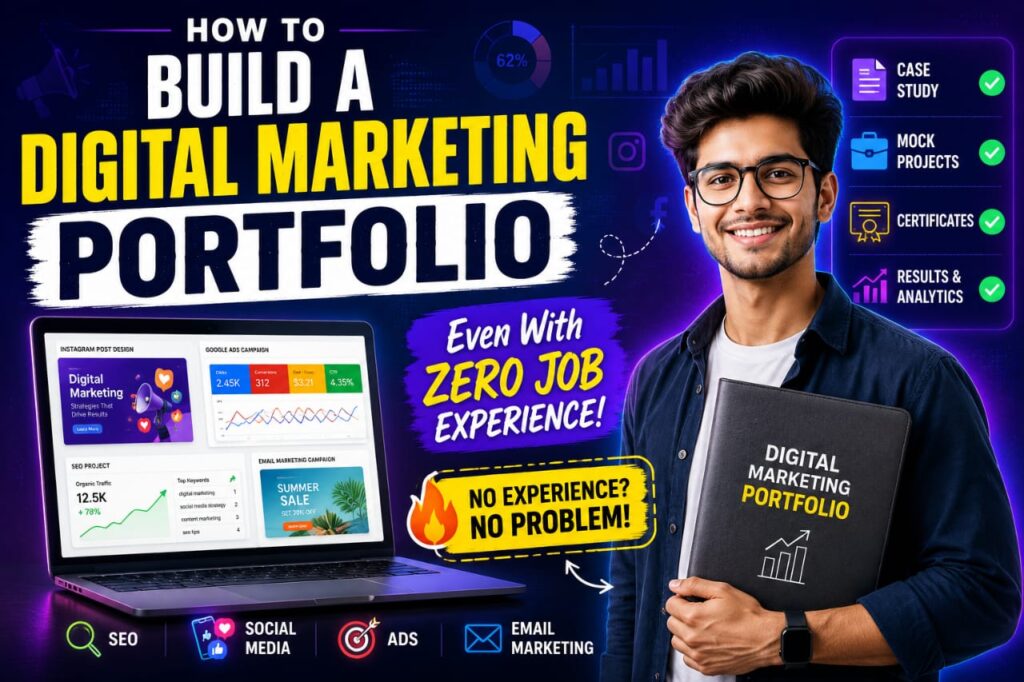
How to Build a Digital Marketing Portfolio: Even With Zero Job Experience
One of the biggest myths in job hunting is that you need years of work experience to have a portfolio. That’s simply not true especially in digital marketing.
A portfolio isn’t a list of past jobs. It’s proof that you understand how to think like a marketer that you can analyze, create, strategize, and execute. Whether you’ve run a personal Instagram page, helped a friend’s business grow, or just practiced on your own projects, that’s portfolio material.
Recruiters today care less about your job title and more about what you can actually do. A strong portfolio can outweigh a thin resume and for freshers, it’s often the deciding factor between getting shortlisted or ignored
Why You Need a Portfolio (Even As a Fresher)
- Resumes tell, portfolios show — Anyone can write “skilled in social media marketing.” A portfolio proves it.
- It builds instant credibility — Real work samples speak louder than buzzwords.
- It differentiates you — Most freshers apply with just a resume. A portfolio puts you ahead instantly.
- It works for interviews too — Instead of explaining your skills, you can show them live.
Step 1: Decide What Type of Portfolio You Need
Not all marketing portfolios look the same. Pick a format based on your strengths and the roles you’re targeting.
| Portfolio Type | Best For |
| Website Portfolio | Long-term branding, SEO roles, freelancers |
| PDF Portfolio | Quick to email, good for job applications |
| Instagram/ LinkedIn portfolio | Social media & content roles |
| Notion portfolio | Easy to build, flexible, great for beginners |
| Behave/ Canva portfolio | Visual/ design-heavy marketing roles |
Step 2: Gather Your Raw Material
Before designing anything, list out everything you’ve ever done that’s even slightly marketing-related.
Ask yourself:
- Have I run social media for a personal page, business, or college event?
- Have I written any captions, blogs, or ad copy?
- Have I designed any posters, posts, or visuals?
- Have I helped any small business, friend, or family member market something?
- Have I done any college projects related to marketing research or branding?
- Have I run any paid or organic campaigns, even small ones?
Step 3: Pick 4–6 Strong Projects (Quality Over Quantity)
You don’t need 20 projects. You need 4 to 6 solid ones that show range.
A good mix includes:
- 1 project showing strategy (a plan, a campaign idea, a content calendar)
- 1 project showing content creation (posts, captions, videos, designs)
- 1 project showing results/data (growth numbers, engagement, reach)
- 1 project showing research or analysis (market research, competitor analysis)
- 1–2 projects showing versatility (different platforms, formats, or industries)
Step 4: Structure Each Project Like a Case Study
This is what separates an amateur portfolio from a professional one. Don’t just show the output — show your thinking.
Use this simple structure for every project:
1. The Goal — What were you trying to achieve?
2. The Strategy — What did you do and why?
3. The Execution — Show the actual work (screenshots, posts, content, designs)
4. The Result — What happened? Use numbers wherever possible.
5. The Learning — What did you learn or would do differently?
Step 5: Design It Simply and Cleanly
Your portfolio doesn’t need to look fancy — it needs to look clear and professional.
Design tips:
- Use a clean, readable font (avoid more than 2 fonts)
- Stick to 2–3 brand colors throughout
- Use plenty of white space — don’t overcrowd
- Add your photo and a short intro at the top
- Include a clear “Contact Me” section at the end
Free tools to build it:
- Notion — Easiest, free, and looks clean instantly
- Canva — Great for visual/PDF portfolios
- Carrd — Simple one-page websites, free tier available
- Google Sites — Free and beginner-friendly
Step 6: Add a Strong Introduction Section
Before recruiters see your projects, they’ll read your intro. Make it count.
Include:
- Who you are (1 line)
- What you specialize in (1–2 lines)
- A standout achievement or unique angle (1 line)
Example:
“I’m a digital marketer who turned a small gifts business into a 200+ order success story using organic social media and local SEO — with zero ad spend. I help brands grow visibility without burning their budget.”
This single paragraph does more than a generic “Hi, I’m a marketing enthusiast looking for opportunities.”
Step 7: Include Skills — But Show, Don’t Just List
Instead of just listing “SEO, Content Writing, Social Media Marketing,” tag each skill to a project where you used it.
Example:
Skills Demonstrated:
- Local SEO → (Gifts Business Case Study)
- Content Calendar Planning → (College Event Promotion Project)
- Copywriting → (Instagram Caption Samples)
- Basic Video Editing → (Reels Project)
Step 8: Make It Easy to Access and Share
Your portfolio is only useful if people can actually see it.
- Keep the link short and clean (use Carrd or Notion’s custom URL feature)
- Add the link to your resume, LinkedIn, and email signature
- If sending as PDF, name the file properly: `YourName_DigitalMarketing_Portfolio.pdf`
- Keep file size small so it opens quickly on mobile
Common Portfolio Mistakes to Avoid
- Including too many projects with no real depth
- Showing only the output without explaining your strategy
- Using generic stock descriptions instead of personal insights
- Forgetting to add results or numbers wherever possible
- No clear contact information or call-to-action at the end
Bonus: What If You Have Zero Real Projects Yet?
If you’re starting from scratch, here’s how to create portfolio material fast:
- Pick a small local business (even a friend’s) and create a sample 1-week content calendar for them
- Recreate an ad campaign for a brand you like and explain what you’d improve
- Run a personal Instagram page for 30 days with a content strategy and document the results
- Do a mock SEO audit of a website and list your recommendations
- Design 5 sample social media posts for a fictional or real brand
Final Thoughts
Your portfolio is your proof of capability, not your job history. Recruiters don’t just want to know what you’ve learned — they want to see how you think, solve problems, and execute ideas.
Start small. Pick your best 4–5 pieces of work, structure them as case studies, and keep refining as you grow. A simple, honest portfolio with real thinking behind it will always beat a flashy one with no substance.
Your portfolio doesn’t need to be perfect — it just needs to start.
Also Read:
Digital Marketing vs Traditional Marketing: Why the Shift is Permanent





