
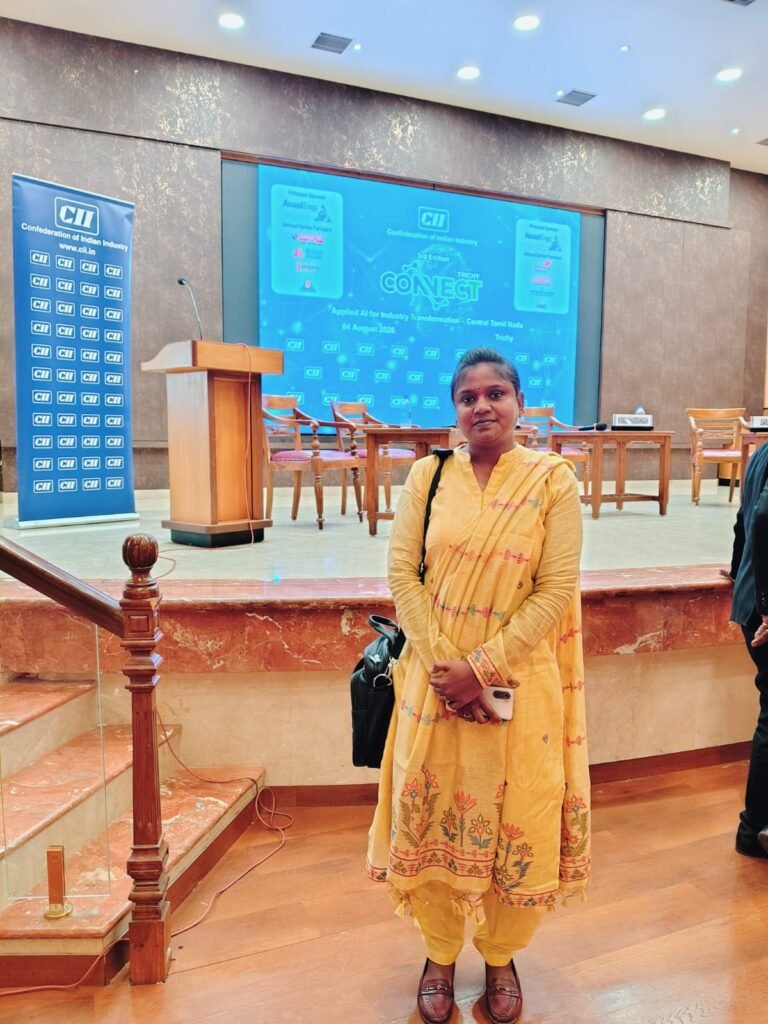
My Takeaways from CII Connect’s “Applied AI for Industry Transformation – Central Tamil Nadu,” Trichy
There are events you attend, and there are events that leave you thinking for days after. This one belonged to the second category.
I attended the session on “Applied AI for Industry Transformation – Central Tamil Nadu” at CII Connect, Trichy, which included a panel discussion on “AI: From Shop Floor to Smart Factory.” Walking out of that room, I felt genuinely thrived and happy — not just because of the ideas exchanged, but because of who was in the room exchanging them: industry leaders, MSME owners, and professors from different colleges across Trichy, all showing up with very different questions but the same underlying concern — how do we actually make AI work for us?
Here’s what stayed with me.
1. Applied AI and Agentic AI: Separating the Real from the Hype
A lot of the conversation circled around what’s genuinely usable today versus what’s still marketing language. Agentic AI is having a moment, but the panel was refreshingly grounded — the consensus was to evaluate these technologies against a real, specific problem rather than getting swept up in what sounds advanced.
2. Domain Skilling Was the Real Star of the Discussion
If there’s one theme that came up again and again, it was domain skilling. Not generic AI literacy, but skilling that’s tied to the specific domain — the machine, the process, the industry. The panelists were clear: you can have the best AI tool in the world, but without people who understand both the domain and the technology, adoption stalls. This is where I think institutes like ours have real work to do — bridging that gap between technical AI skills and domain-specific application.
3. Connecting with the GCC Ecosystem
There was a strong thread on how Trichy and Central Tamil Nadu businesses can plug into the Global Capability Centre (GCC) ecosystem — a reminder that this region isn’t isolated from the bigger AI and technology conversation happening in metros. The opportunity is there; it just needs the right bridges.
4. How Big Machinery Industries Are Actually Deploying AI
Rather than talking in the abstract, panelists shared real deployment stories — how large machinery and manufacturing units are using AI on the shop floor. The recurring advice: start with the problem, not the technology, and justify every step on effort and ROI, not on how sophisticated it sounds.
5. Data Handling and Cybersecurity — Not an Afterthought
This was one of the most practical parts of the discussion. AI cannot help you with data you never recorded — data availability comes first, always. And as more machines get connected, every connection becomes a potential door for a cyber threat. Cybersecurity needs to be part of the AI conversation from day one, not bolted on later.
6. Cloud Infrastructure Is the Great Equalizer
For MSMEs especially, cloud infrastructure is what makes AI adoption affordable and scalable. Without it, a lot of this conversation would remain out of reach for smaller players.
The Bigger Picture: It’s All About Readiness
If I had to sum up the entire session in one line, it would be this: the room wasn’t really talking about AI. It was talking about readiness.
- Data readiness — do you even have the data you need?
- Skill readiness — do you have people who understand both the domain and the tools?
- Infrastructure readiness — is your cloud and cybersecurity foundation solid enough to support this?
AI doesn’t wait for readiness. But adoption does. And that gap — between the pace of AI and the pace of organisational readiness — is exactly where training and skilling initiatives need to step in.
Why This Matters for Digital Toppers
Sessions like this reaffirm why we do what we do at Digital Toppers. Domain skilling, AI-in-marketing training, and building practical, deployment-ready skills for students and businesses in Trichy isn’t just about keeping up with trends — it’s about closing the readiness gap that industry leaders are talking about on stages like this one.
My thanks to CII for putting together a genuinely relevant agenda, and to the panelists and moderator for such an open, practical discussion.