
Today, customers expect everything to be fast, simple, and personal. They don’t want to visit multiple websites, wait for replies, or go through complicated steps just to buy a product.
That’s exactly where WhatsApp becomes powerful.
Most people already use WhatsApp daily—to chat with friends, family, and even businesses. For small business owners, this is not just a messaging app. It’s a direct line to customers.
Instead of spending heavily on ads or building complex systems, you can use WhatsApp to connect, build trust, and grow your business in a more natural way.
Why WhatsApp Works So Well for Businesses
WhatsApp is not like traditional marketing platforms. It feels personal.
When a customer messages you, it doesn’t feel like they are talking to a brand. It feels like they are talking to a real person.
That small difference creates a big impact.
- Customers trust faster
- Conversations feel natural
- Decisions happen quickly
And most importantly—people reply on WhatsApp.
1. Direct Communication Builds Instant Trust
One of the biggest advantages of WhatsApp is instant communication.
Imagine a customer who is interested in your product but has a small doubt:
- Price
- Size
- Delivery time
If they message you and get a quick reply, their confidence increases immediately.
More trust = Higher chances of purchase
Fast replies mean more trust.
2. WhatsApp Status = Free Daily Marketing
Many people check WhatsApp status every single day. This is an underrated feature for businesses.
You can use it like a free advertising tool.
What you can post:
- New product arrivals
- Offers & discounts
- Customer reviews
- Behind-the-scenes content
- Short product videos
Even if customers don’t message immediately, your brand stays in their mind.
3. Turn Chats into Sales (Real Power of WhatsApp)
Unlike websites where customers browse and leave, WhatsApp allows you to guide the customer step-by-step.
A simple journey looks like this:
- Customer sends a message
- You respond instantly
- You share product details/photos
- Customer asks questions
- You clarify
- Customer buys
Simple process, smooth experience, faster decisions
This is why WhatsApp often gives higher conversion rates than traditional methods.
4. Real Example: How Flipkart Used WhatsApp Chatbots
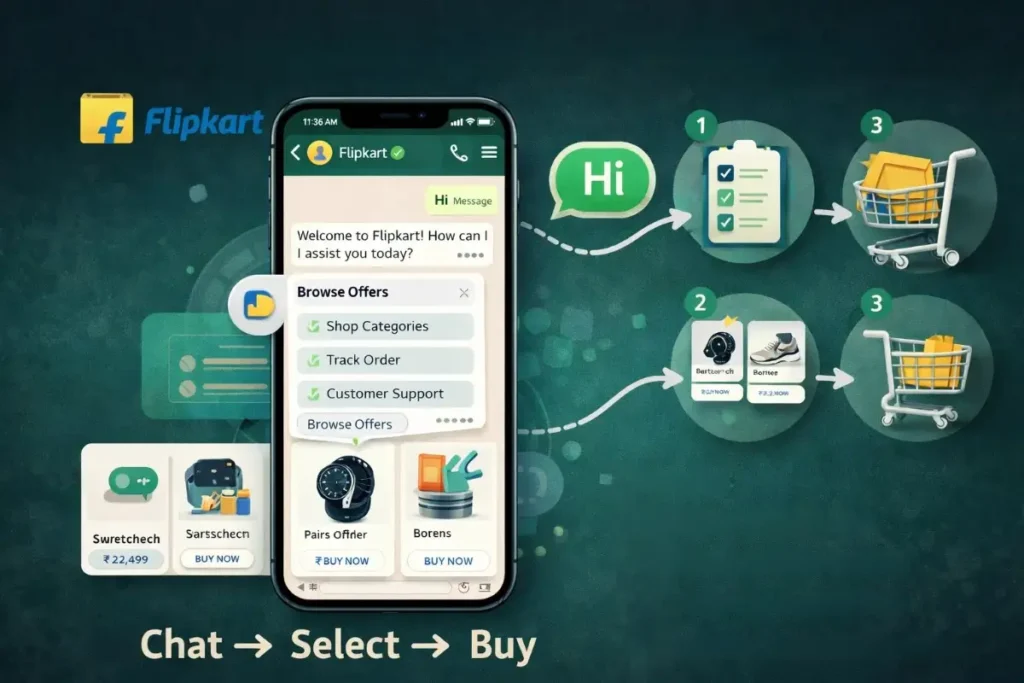
A great real-world example is Flipkart, one of India’s leading e-commerce platforms.
During their major sale campaign, they used a WhatsApp chatbot to simplify the shopping experience.
What They Did
Customers could simply send a message like “Hi” and instantly get
- Browse offers
- Explore product categories
- Get personalized recommendations
- Track orders
- Receive instant support
Everything happened directly inside WhatsApp.
How the Chatbot Worked
- User sends a message
- Chatbot shows menu options
- User selects what they want
- Instant responses guide them
- Product links are shared
- Purchase happens (fast & easy)
Clear communication, quick responses
Why It Was Effective
- No need to open websites
- Instant replies
- Simple navigation
- Personalized experience
This reduced effort for customers and increased buying.
Results
- Higher engagement
- Faster decision-making
- Increased conversions
- Better customer experience
In simple terms:
Chat → Select → Buy
5. Actionable Insights for Small Business Owners
You don’t need to be a big company to use this strategy.
You can create a simple version:
Boutique:
- “Hi” → New Collection / Offers
- Auto reply → Product images + price
Bakery:
- “Hi” → Cakes / Custom Orders
- Instant menu + photos
Same concept, smaller scale — still powerful.
6. Optimizing WhatsApp Business Features for Growth
If you want serious growth, don’t just use WhatsApp normally. Use WhatsApp Business features smartly.
Quick Replies & Automation
Save time and respond faster.
- Answer common questions instantly
- Set greeting messages
- Use away messages when offline
Makes your business look professional
Product Catalog (Mini Shop Inside WhatsApp)
Instead of sending multiple images manually, you can create a catalog.
- Show product images
- Add price & details
- Share instantly in chat
Customer can browse without leaving WhatsApp
Fewer steps, more sales
Labels & Customer Segmentation
As your business grows, managing customers becomes important.
You can organize like this:
- New customers
- Interested users
- Repeat buyers
Send the right message to the right people
Avoid spam feelings.
Broadcast Messages (Smart Promotion)
You can send updates to multiple people at once—but it still feels personal.
Use it for:
- Festival offers
- Product launches
- Limited-time deals
Personal feel + Mass reach = Perfect combo
7. Customer Support = Business Growth
Good customer service is one of the biggest reasons people come back.
With WhatsApp, you can:
- Answer queries quickly
- Share order updates
- Solve problems fast
- Collect feedback
When customers feel supported, they:
Buy again, Recommend your business
8. Cost-Effective Marketing (High ROI)
Compared to ads, WhatsApp is extremely affordable.
- No big budget needed
- High engagement
- Better response rate
You spend less, You earn more
That’s why many businesses see better ROI using WhatsApp.
9. Perfect for Small & Local Businesses
WhatsApp is especially powerful for:
- Home businesses
- Boutiques
- Bakers
- Freelancers
- Local service providers
Why?
Because your audience is already there.
They don’t need to download anything new or learn anything complicated.
10. Common Mistakes to Avoid
Even though WhatsApp is simple, using it the wrong way can reduce results.
Avoid this:
- Sending too many messages (spam)
- Late replies
- Dry or robotic communication
- Ignoring customer queries
Instead:
- Be friendly
- Be quick
- Be helpful
Final Thoughts
Growing a business doesn’t always require complicated strategies.
Sometimes, the most powerful tools are already in your hands.
WhatsApp is more than just a messaging app.
It’s a complete business tool—marketing, sales, and customer support in one place.
Start simple:
- Reply fast
- Share useful updates
- Build real conversations
Over time, those conversations will turn into customers…
and those customers will turn into long-term growth.